Pallet Flow Rack Systems in Richmond, VA
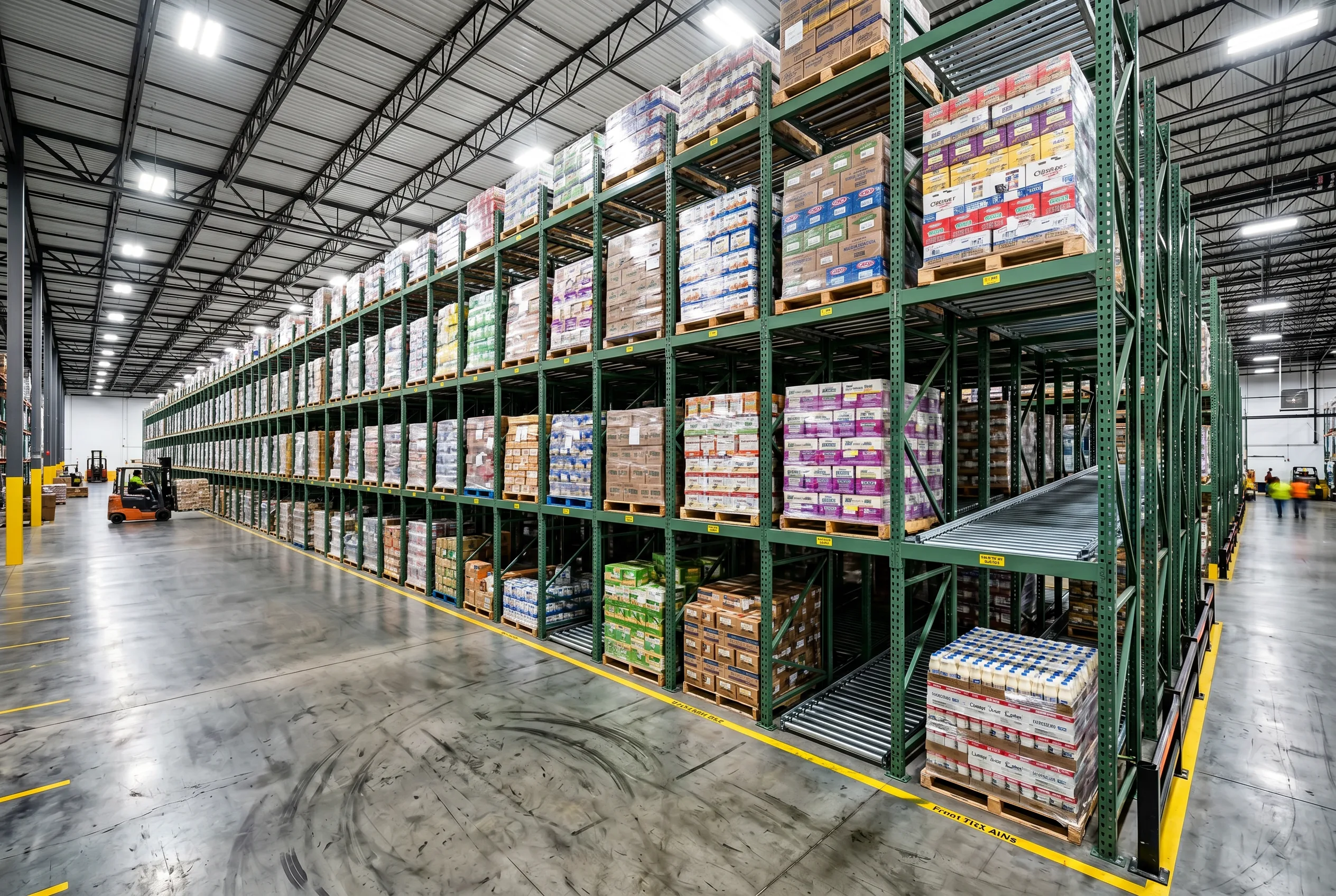
FIFO gravity-fed pallet rack — 2 to 20 pallets deep, separate load and pick aisles, automatic rotation for dated inventory.
Ready to get started? Get a free, no-obligation quote today.
About Pallet Flow Rack
Pallet flow rack is a gravity-fed deep-lane storage system where pallets are loaded at the back of a lane, roll forward automatically on inclined roller tracks, and arrive at the pick face in FIFO (first in, first out) order. Each lane can run 2 to 20 pallets deep, with speed-control brake rollers keeping flow predictable and safe. Separate load and pick aisles eliminate forklift travel between the two operations — a major cycle-time improvement at distribution-center scale. Pallet flow is the default choice for Richmond cold-chain grocery, dairy, pharmaceutical, and beverage distributors where code-date rotation is mandatory and lane depth is the planning unit. Richmond Warehouse Racking designs, supplies, and installs pallet flow systems engineered to IBC 2021 with Virginia amendments and RMI ANSI MH16.1-2023, with full seal-stamped structural drawings for every Greater Richmond metro installation.
How Pallet Flow Rack Works
Load from the rear aisle
A forklift in the dedicated load aisle places a pallet at the back of the inclined roller lane. Each lane is pitched roughly 3 to 4 percent front-to-back.
Gravity feeds the lane forward
The pallet rolls forward on gravity-powered steel rollers or skate wheels at a speed controlled by centrifugal or hydraulic brake rollers spaced every 4 to 8 feet.
Pick from the front aisle
The pallet arrives at the front pick face in FIFO order — the oldest pallet in the lane is always next to pick, enforcing rotation automatically.
Two aisles, zero conflict
Load and pick operations happen in different aisles, so forklifts never cross paths. That eliminates congestion in high-velocity distribution and cuts cycle times dramatically.
System Specifications
- Lane depth
- 2 to 20 pallets deep
- Pallet capacity
- 2,500 lbs standard, up to 4,000 lbs structural
- Rotation
- FIFO (First In, First Out) — enforced automatically
- Flow mechanism
- Gravity rollers or skate wheels at 3–4% pitch
- Speed control
- Centrifugal or hydraulic brake rollers every 4–8 ft
- Pallet quality required
- GMA-grade or better — damaged pallets jam the lane
- Upright style
- 3" × 3" structural channel, heavy-gauge
- Aisle layout
- Separate load and pick aisles
- Code compliance
- IBC 2021 (Virginia amendments), RMI ANSI MH16.1-2023
- Richmond seismic / wind
- SDC A–B, wind per ASCE 7 (110 mph 3-sec gust)
Is Pallet Flow Rack Right for Your Operation?
Choose Pallet Flow Rack when…
- FIFO rotation is mandatory — dated food, pharma, beverage, or regulated inventory
- You need deep lanes (7+ pallets) beyond what pushback supports
- Throughput is high enough that separate load/pick aisles pay back in labor saved
- You run a homogeneous-SKU lane model (same SKU down the full lane depth)
- Cold storage where reducing aisle count cuts refrigeration-load square footage
Consider alternatives when…
- LIFO is acceptable and budget is tight — pushback costs significantly less
- Your pallet condition varies — flow will not tolerate damaged stringers or warped decks
- You need high SKU selectivity per bay — stay with selective racking
- Low-velocity storage where automated FIFO would rarely get used
Pallet Flow vs. Other High-Density Options
| Attribute | Selective | Pushback | Drive-In | Pallet Flow |
|---|---|---|---|---|
| SKU selectivity | 100% | Medium (per lane) | Low (per bay) | Low (per lane) |
| Rotation | Any (FIFO or LIFO) | LIFO | LIFO | FIFO (automatic) |
| Lane depth | 1 pallet | 2–6 pallets | 2–10 pallets | 2–20 pallets |
| Forklift enters rack | No | No | Yes | No |
| Rack-damage exposure | Low | Low | High | Low |
| Density vs. selective | 1.0× | 1.8–2.0× | 2.0–2.5× | 2.5–3.0× |
| Separate load/pick aisles | No | No | No | Yes |
| Relative cost per position | $ | $$ | $$$ | $$$$ |
Highlighted column shows how pallet flow rack stacks up across the most common high-density alternatives.
Product Features
- Lane depths from 2 to 20 pallets, engineered to your throughput and SKU velocity
- Gravity roller tracks with centrifugal or hydraulic brake-roller speed control
- Separate load and pick aisles — no forklift conflict between the two operations
- Structural-channel uprights rated for deep-lane, high-capacity loading
- Compatible with GMA-grade and heavy-duty pallet specifications
- Engineered to IBC 2021 (Virginia amendments) and RMI ANSI MH16.1-2023
- Sealed structural drawings provided for every Richmond metro installation
Benefits for Your Business
Pallet Flow Rack — Frequently Asked Questions
How deep can a pallet flow lane be?
Engineered lane depths run 2 to 20 pallets. Most Richmond food and pharma installations land between 8 and 15 deep, sized to match typical pre-shipment staging volume per SKU. Depths beyond 15 require strict attention to pallet-quality consistency — a single bent stringer can jam the lane and require a retrieval operation.
What pallet quality does pallet flow require?
GMA-grade 4-way pallets in solid condition are the baseline. Damaged stringers, splintered leading edges, or warped decks will hang up on rollers or skate wheels and cause jams. If you cannot guarantee GMA-grade quality across your inventory, pushback or selective is more forgiving.
Can I mix SKUs in a pallet flow lane?
Technically yes, but FIFO picks in the order pallets were loaded — so mixing SKUs defeats the main advantage. Most flow installations run one SKU per lane, with lane depth sized to equal typical pre-shipment volume for that SKU.
How fast do pallets flow down the rollers?
Brake rollers limit free-flow speed to roughly one foot per second. Every 4 to 8 feet of lane depth adds another brake. A loaded pallet rolls from back to front in a 15-deep lane in roughly 15 to 30 seconds — predictable, slow enough for safety, fast enough for operations.
How does pallet flow compare to drive-in rack?
Drive-in delivers similar or greater density at roughly half the capital cost, but it rotates LIFO only and exposes the rack to forklift-entry damage. Pallet flow costs more and demands better pallet quality, but enforces FIFO automatically, eliminates in-rack forklift traffic, and separates load and pick aisles. The decision almost always comes down to whether the product requires FIFO.
What is the ROI picture for pallet flow?
Pallet flow is the highest capital cost per position of the major rack types, but the ROI is in labor and compliance. Eliminating manual FIFO enforcement, cutting forklift travel 40–60% with separate aisles, and avoiding expired-inventory write-offs typically produces a 24 to 48 month payback for Richmond cold-chain and pharmaceutical distributors.
Get a Free Quote
Contact us today for a no-obligation quote on pallet flow rack for your Richmond metro facility.
Request Free Quote (804) 555-0100Free, no-obligation quotes
Professional installation available
Licensed & fully insured
Serving all Richmond metro areas
Ready to Optimize Your Warehouse?
Get a free estimate from Richmond's most trusted pallet racking company. We serve warehouses of all sizes throughout the Greater Richmond metro.